

Top 5 PPC Trends to Watch in 2026

The old ways of managing paid search have come to an end with manual bidding, keyword micro-management, and basic matching-type strategies losing their effectiveness. Over the past two years, there has been a greater than ten-fold change in PPC, with the use of AI responsible for affecting all major shifts.
Advertisers who adapt to the top five PPC trends identified below will experience substantially greater success than those that continue to run traditional paid search campaigns. These are the PPC trends that will shape paid advertising in 2026.
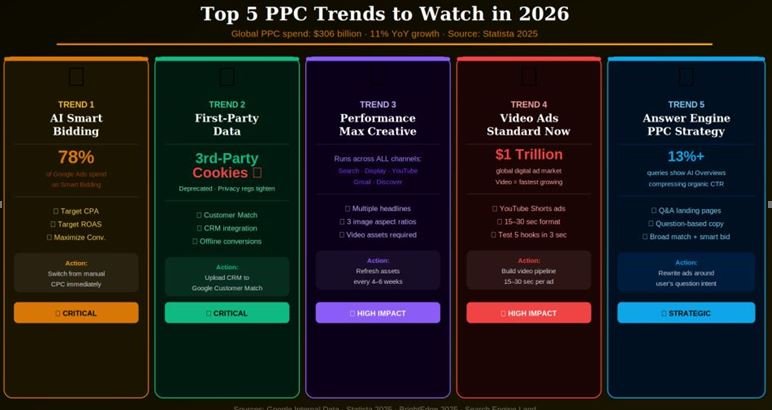
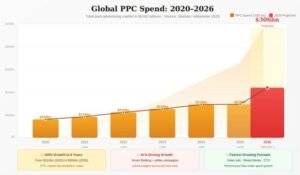
Estimation for global PPC expenditure of $306 billion by 2026, increased by 11% since 2025 (Statista, 2025).
At a Glance: The Top 5 PPC Trends in 2026
| # | PPC Trends | Impact Level | Action Required |
| 1 | AI-Powered Smart Bidding as Default | 🔴 Critical | Switch to Target CPA or Target ROAS immediately |
| 2 | First-Party Data as Competitive Advantage | 🔴 Critical | Build Customer Match audiences from your CRM |
| 3 | Performance Max Demands Better Creative | 🟠 High | Diversify asset groups; add video assets |
| 4 | Video Ads Are Now Standard Format | 🟠 High | Build a 15–30 second video production pipeline |
| 5 | Search Is Becoming an Answer Engine | 🟡 Strategic | Restructure ad copy and landing pages around Q&A |
PPC TRENDS 1: AI-Powered Smart Bidding Is Now the Default
78% of money spent on Google Ads is now directed through smart bidding (Google Internal Data, 2025).
AI technology leverages real-time bidding through millions of data points that include device type, location, time of day, search intent and user history at the same time. Manually replicating this type of capability across all signals is simply impossible (through human input). The role of the advertiser has changed from providing tactical adjustments to making better strategic inputs.
Better inputs = better outputs. The quality of the conversion tracking you have set up for your account will now dictate the ceiling of your campaign’s performance. It no longer matters how well you could adjust your bids manually; the quality of your conversion tracking is now the determining factor.
Better data in means better performance out. The quality of your conversion tracking and goal setup now determines your campaign’s ceiling — not your manual bid adjustments.
💡 Action: Transition from manual cost-per-click (CPC) to Target Cost-Per-Action (TCPA). oTargetReturn-on-Advertising-Spend (TROAS). Set-up conversion actions that are linked to true business value—closed sales and qualified leads, not simply form submissions.
PPC TRENDS 2: First-Party Data Is Now a Competitive Advantage
With the phase-out of third-party cookies and an increase in global privacy regulations, marketers with superior first-party data infrastructure are continuing to outperform all other marketers.
When advertisers with strong first-party data infrastructure submit quality audience information into the data model, it provides a consent-based source of data that feeds the AI bidding system and is used as accurate data feeds for bidding purposes. The platforms reward those advertisers by providing more effective audiences. Conversely, if complete or incomplete audience information is provided to the data models, the algorithms will use either completely or partially inaccurate data as their historical-based information and will waste your allocated budget optimizing towards undesired results.
Creating a good audience for your campaigns can help you get better results. In Google Ads, create an audience using your customer contact list from your CRM. Upload any past conversion data from your CRMs to demonstrate the revenue that came about from each conversion, not just clicks.
PPC TRENDS 3: Performance Max Campaigns Demand Better Creative
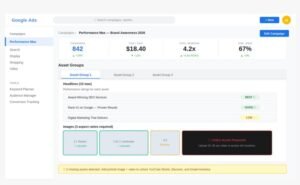
Performance Max is now the only type of ad that runs on Search, Display, YouTube, Gmail, and Discover at the same time through a single campaign. All Google Ads accounts create pMax campaigns by default; therefore, targeting and bidding are done automatically by the AI engine.
Because of this you have the most important piece of control—that is, your creative assets. The AI engine will be able to test many different versions of your headlines, images, or videos faster than any human could.
The main takeaway here is that the AI cannot create great creative work—it can test great creative work. If the creative input is weak, the results will be weak regardless of how sophisticated the algorithm is.
- Upload lots of different headlines and descriptions to provide the AI multiple options to test.
- Provide lots of different pictures in multiple aspect ratios (1:1, 1.91:1, and 4:5).
- Include at least one video asset per video asset group. Without videos in a campaign, there will be fewer impressions available.
Action: Think of spending money on Performance Max kind of like spending money on a creative brief, rather than treating them like a once-and-done campaign. Keep your creativity updated every 4-6 weeks to avoid creative fatigue.
PPC TRENDS 4: Video Ads Are Now a PPC Requirement
📊 The global digital advertising industry reached one trillion dollars in 2025. The fastest-growing niche within this sector is video advertising, with a noticeable amount of cost per acquisition (CPA) reductions occurring across numerous industries due to the impact of video ads on both YouTube and TikTok (Performance+).
Due to the high speed of fatigue developing with personalization in creative assets, brands must have a continuous creative pipeline as opposed to just one hero video; otherwise, they will lose the potential ability to measurably affect their lower-funnel performance.
💡 Action: Create a minimum of three to five different hooks in your first 3 seconds of direct response videos that last for 15 to 30 seconds to maximize your chance of getting users to feel compelled to watch (to view) your video and determine the real differences in performance.
PPC TRENDS 5: Search Is Becoming an Answer Engine — Adapt Your PPC Strategy
📊 In 2026, more than 13% of all queries were answered using Google AI Overviews which contained direct answers located within the result page itself (thus decreasing the organic click-through rate [CTR]). At the same time, the introduction of Google AI has created a new dimension in which advertisers are able to position their PPC ads relative to the user’s intent.
Moreover, with the increase in intensity of the users’ intent within their queries as a result of the increasing use of voice recognition, broad matches with smart bidding now also capture a broader range of users’ relative conversation-based intent than would have been the case if only using an exact match.
Action: Look up your Search Queries Report and see which queries are in their form of a question—then update the ad copy accordingly to target the actual issue being faced by the user (not just features of your product). Also consider providing a clear “Q/A” at the landing page to help improve your quality score and conversion rates.
Frequently Asked Questions
Q: What are the biggest PPC trends in 2026?
The five biggest ongoing PPC trends will be: 1) Smart bidding using AI will be standard by far, 2) First party data will become a necessary part of any competitive advantage, 3) Performance Max campaigns will require much more effective creative, 4) The use of video ads as a regular part of PPC, and 5) Search will continue evolving into an answer engine and therefore change how you write ad copy.
Q: Is manual PPC bidding still worth it in 2026?
For most accounts -No. Since Google now manages 78% of Ad Spend using Smart Bidding, Manual CPC bidding is usually outperformed by either Target CPA or Target ROAS Bidding. Manual Bidding only works for very small accounts with little conversion data.
Q: How does AI affect PPC advertising?
Within PPC automation, AI is used in managing bids in real time, expanding the available audiences, testing creative elements, and dividing up budgets. The role of the advertiser has been shifted from tactical execution to strategic direction: Setting Goals, Providing Quality Data, and Providing Creative Direction.
Q: What is Performance Max and should I use it?
Performance Max (pMax) is a new Google campaign type that is based on machine learning and runs across multiple channels at once (i.e., Search, Display, YouTube, Gmail). Most accounts should try out this new functionality; however, it requires a variety of ad creative to perform optimally, as well as a clear understanding of conversions in order for it to be successful. Without quality inputs, Google’s algorithms will sometimes optimize for undesirable KPIs.
Q: How do I future-proof my PPC strategy?
To best prepare your PPC strategy for the future, you’ll need to focus on three key areas: 1) Data quality – establish an effective and accurate method for tracking conversions (i.e. measuring true value to the business); 2) Creative pipeline – develop a streamlined process for producing fresh and diverse ad creative including video; 3) Strategic oversight – utilize all available resources (human intellect, machine learning) when planning, executing, and measuring the results of your advertising campaigns.