How to Fix a Drop in Website Ranking Fast

Introduction
If your website ranking drops, that means Google has moved your web pages further down its search results — typically due to an algorithmic update, a technical issue or your site having lost backlinks — and/or due to the fact that they no longer consider your content to be sufficiently valuable. There are usually several reasons for ranking drops; if you understand the reason for your website ranking drop, it’s typically possible to fix it. This is a guide that will help you identify the issue(s) affecting your site’s ranking, and will outline how to remedy the situation, so you’ll be able to return to your original position.
If you operate a company located in Salem, Oregon then an increase/decrease in your company’s website ranking is one of the most significant aspects of your online marketing strategy. A company’s drop in rank could mean reduced number phone call inquiries, reduced number form submissions and lower revenue; this can happen very quickly. Fortunately, your website’s ranking is very rarely permanent; if you accurately determine what caused it to happen, you can work on a recovery process and develop a plan to protect against future ranking drops.
Google makes many changes to its ranking algorithm each year. Some of these changes are minute changes that rarely go unnoticed; other types of algorithm changes known as core updates are large enough that they can affect the rankings of the thousands of companies’ websites. Understanding the type of algorithm change that affected your company’s website is the first step in creating a solid plan to recover from a decline in your webpage’s Google rankings.
Why Do Website Rankings Drop? The 6 Most Common Causes
It’s essential to know what caused the website ranking issue before solving it. As per Google Search Central, Google releases between 4,000 and 5,000 algorithm changes annually. According to Google Search Central, Core updates alone affect up to 40% of tracked keywords concerning websites within 30 days of the change.
The following are six of the most prevalent reasons websites lose their ranking:
Google Core Update: Periodically, Google reassesses the types of content that should rank highest on the internet. Your content may no longer be trustworthy enough to maintain its previous position.
- Google Core Update: Periodically, Google reassesses the types of content that should rank highest on the internet. Your content may no longer be trustworthy enough to maintain its previous position.
- Technical Issues: Technical issues such as crawl errors, broken pages, slow loading times, or missing canonical tags can negatively impact your ranking even if you haven’t made any changes to your content.
- Lost or Banned Links: If you lose links from reputable websites or, conversely, begin to receive links from spammy sites, your authority drops, negatively impacting your ranking.
- Declining Quality of Content: Thin pages, duplicated content, or content that no longer addresses a searcher’s needs can result in a steady decline in your ranking.
- Google Manual Penalty: In extreme cases, Google will label a site as violating guidelines manually. You can see in the Google Search Console and it will result in a sudden drop in your site’s ranking.
- URL Changes and Site Migration: If you change your web address or change URLs without re-directing appropriately, you risk losing ranking equity.
How to Diagnose a Website Ranking Drop — 7 Steps
To avoid wasting time fixing your drop, follow these 7 steps and work through each step before making any corrections to your web site.
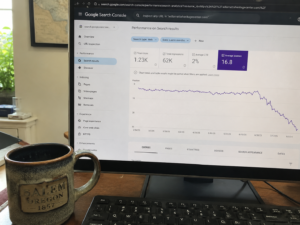
- First, check out Google Search Console (Go to Performance section, view different time ranges around drop date). Also check the Coverage section for Crawl Errors, and also Manual Actions for any Penalties. This first step will generally narrow down the cause of the drop.
- Compare your drop in ranking dates with any major Google Updates. Use tools like Semrush Sensor or MozCast to check when there were major Google updates. If your website drop occurred within one week of a major Google update, than the major Google Update is the probable cause.
- Conduct a complete crawl of your website using Screaming Frog or Sitebulb. Review for the following: 4xx Errors, Redirect Chains, Duplicate Title Tags and Missing Canonical Tags. All of these can cause a reduction in your website ranking without you being aware of it.
- Use Ahrefs or Majestic to complete an audit of your backlinks. Check for any links that have been lost from high-authority domains, as well as any new low-quality links pointing to your website.
- Test your Core Web Vitals with PageSpeed Insights. Google uses LCP, INP, and CLS as ranking factors. A drop in these factors will affect how your website is ranked, especially on mobile devices.
- Find the pages that lost the most clicks or impressions. Look at the top-ranking pages for those same keywords and compare the format, quality, or freshness of your content.
- Look for duplicate content and canonical errors. These pages are competing for ranking authority with each other & cause confusion to Google in choosing which page will be displayed in search results.
Types of Website Ranking Drops — Quick Reference
Use this table to determine what symptoms you are experiencing and what likely causes may be behind these symptoms to assist you in determining how to best resolve your ranking drop.
| Drop Type | Scope of Impact | Recovery Timeline | Best Diagnostic Tool |
| Google Core Update | Broad — many keywords and pages affected together | 3–6 months (usually next update cycle) | Google Search Console + algorithm tracker (MozCast) |
| Technical SEO Issue | Specific pages or sections of the site | Days to weeks once fixed | Screaming Frog, Search Console Coverage report |
| Manual Penalty | Specific pages or entire site — clearly flagged in GSC | 2–8 weeks after reconsideration request | Google Search Console → Manual Actions tab |
| Backlink Loss | Gradual slide on specific pages | 6–12 weeks of link rebuilding | Ahrefs Lost Links report |
| Content Devaluation | Gradual loss when competitors improve | 4–8 weeks after content upgrade | Search Console + SERP comparison |
How to Recover Website Ranking — 8 Proven Fixes
Once you determined the cause, work on these fixes in order of priority. As you correct technical issues/course the issues first — the issues will often be resolved quickly and significantly better your site ranking on your return visits.
- Address all technical issues based on your crawl reports. Prioritize fixing 404 errors, redirect chains and Core Web Vitals errors and submit your fixed URLs to Google Search Console for expedited re-indexing.
- Fix your dropping pages so they will rank better. To do that, add more depth, originality, expert insight on your subject matter and clear structure to these pages. Thin content is the main reason for website rankings to drop after a core update.
- Rebuild or retrieve lost backlinks. Reach out to any sites that have stopped linking to you to get them to link again. Fix all broken internal links to aid in maintaining a strong internal linking structure for your website long-term.
- Submit a reconsideration request if you have received a manual penalty. Document every change you made to resolve the violation. Google’s team will review the request within a few weeks.
- Improve your E-E-A-T signals. Include author bios that specify their credentials, reference original sources, and use real expertise throughout your content. This is one of the strongest signals for your website to rank well with Google.
- Increase your page speed. Reduce size of images, eliminate render-blocking scripts, and use a CDN; web page speed is also a contributing factor to bounce rates and directly impacts web page ranking factors.
- Determine if the purpose of search engine results has changed. If the primary results returned are video or local information for the specific keyword you are targeting then it is likely that the content you are providing may not be relevant to what someone is now looking for.
- Build your office topic by providing additional blog articles supporting your main pages; build topical clusters, which makes the whole topic stronger and increases the ranking of the total page, rather than just one page.
How Long Does Website Ranking Recovery Take?
The answer to that question is how quickly did you make the necessary changes to remove the cause of the drop in ranking and how long will it take for those changes to be reflected in Google’s index. Below is an estimated time table.
| Issue Type | Typical Recovery Time | What Speeds Up Recovery |
| Google Core Update | 3–6 months — usually tied to next core update | Significant content quality improvements + strong E-E-A-T |
| Technical Fix (crawl errors) | 2–4 weeks after correction | Submit fixed URLs for re-indexing immediately in GSC |
| Manual Penalty (resolved) | 4–8 weeks after reconsideration request | Clear, thorough documentation of every change made |
| Backlink Loss | 6–12 weeks of active link rebuilding | Replacing links with same or higher authority equivalents |
| Content Quality Upgrade | 4–8 weeks per improved page | Significant depth addition, new data, better formatting |
Visualisation: Screenshot of a simple line chart, where x=Weeks (1-12) y=Average Ranking Position of your website each of the 12 weeks. You should see a flattening of your ranking by the end of week 4 and your rank will begin to recover between week 6 and 12, assuming that all of your fixes have been indexed.
Protecting Your Website Ranking Long-Term
The best time to protect your website’s ranking is now, before you have lost it. Create habits which will allow you to react quickly to an algorithm update.
- Set up a weekly monitoring system to monitor the rankings of your keywords using the Google Search Console and a rank monitoring tool such as Semrush or Ahrefs (You will know within days if your rankings have changed).
- Run a technical SEO audit every quarter. Do not wait for a drop to check for crawl errors, broken links, or page speed issues.
- Keep an update log. Every time Google confirms a core update, note the date and check your website ranking data from that week. Patterns become clearer over time.
- Diversify your traffic sources. Email, social, and referral traffic give you a cushion when your website ranking dips. Over-reliance on organic is a fragile strategy.
- Publish content consistently. Google rewards sites that stay active and fresh. A stale blog or outdated service page signals that your site may not be the best result anymore.
- For Salem, OR businesses: maintain consistent NAP (name, address, phone) across all local citations. Local citation consistency directly supports your local website ranking in the map pack and organic results.
Frequently Asked Questions
Q: Why did my website ranking drop overnight?
A: A sudden website ranking drop is most often caused by a Google algorithm update, a technical change like a mis-configured robots.txt, an accidental noindex tag, or a sudden surge of toxic backlinks. Open Google Search Console and check the Manual Actions tab and the Coverage report. Then cross-reference your drop date with Google’s confirmed update history using a tool like MozCast or the Google Search Status Dashboard.
Q: How do I recover my website ranking after a Google core update?
A: Core update recovery is not about quick fixes — it is about genuinely improving content quality. Focus on adding real expertise and depth to pages that lost website ranking, matching your content format to what searchers actually want today, and strengthening your E-E-A-T signals with author credentials and original research. Full recovery usually comes with the next core update, typically 3–6 months later.
Q: Does a Google penalty affect my whole site’s website ranking?
A: It depends on the penalty type. A page-level manual penalty only affects the specific URLs flagged. A site-wide penalty drops your website ranking across all pages. Algorithmic penalties from core updates are not manually applied — they affect pages based on quality signals. Check Google Search Console under Manual Actions to see if a formal penalty has been issued.
Q: How long does website ranking recovery take?
A: Technical fixes like resolving crawl errors can show website ranking improvement within 2–4 weeks once Google re-crawls the corrected pages. Content improvements take 4–8 weeks per page. Manual penalty recovery takes 4–8 weeks after a reconsideration request is accepted. Core update recovery typically aligns with the next major update, which can be 3–6 months away.
Q: Why did my website ranking drop overnight?
Google updates, technical issues, or toxic backlinks can commonly cause this issue. To determine the problem, it would help you to check the Console for errors or if there are manual actions.
Q: How do I recover my website ranking after a Google core update?
In order to recover your ranking from a Core Update, strengthening the E-A-T signals you send to the search engines will help. Improving the quality of your content, developing expertise and being a source of trust for your customers or readers can achieve this. Obtaining recovery may take as long as the next update.
Q: Does a Google penalty affect my whole site’s website ranking?
No, a penalty impacts only certain pages on your site, or an entire site depending on the severity of the penalty. To find out how your site has been impacted you must refer to the Search Console for the information.
Q: How long does website ranking recovery take?
Technical fixes can show recovery from 2-4 weeks; content and core update recovery takes the longest at months.
Conclusion
if you’ve seen a decline in your website ranking, don’t worry. First figure out what’s causing the issue, then implement the appropriate fixes and develop a long-term strategy for implementing good SEO. Companies that are proactive about maintaining their SEO will also be more resilient to ranking drops than competitors who do not invest in ongoing SEO efforts.
For any companies that have experienced a decline in rankings, AGTC provides complimentary SEO audits to businesses in Salem, Oregon. Give us a call to learn more.