

Programmatic SEO for Beginners: A Simple Guide


Introduction
Most owners of websites are dealing with the same issue: creating enough content to be ranked in Google has always been slow, costly, and nearly impossible to scale. That’s where programmatic SEO dramatically alters the game.
Programmatic SEO uses both structured data and page template(s) to create multiple pages (hundreds or even thousands) that are fully optimized using an automated process. Companies such as Zillow, Airbnb, and Zapier have built their businesses based on this one very simple strategy—if you have a repeatable keyword structure and you’re using actionable data, then you can do it too.
According to studies, Zapier is currently ranking for more than 50,000 different queries related to app integration — they do this by automatically generating pages from structured templates through the use of programmatic SEO.
How Does Programmatic SEO Actually Work?
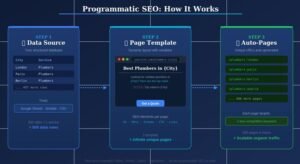
Programmatic SEO has three essential building blocks. You should think of it in the same terms as a mail merge—but instead of creating personalized letters, you’re creating thousands of search engine optimized landing pages using programmatic SEO.
The Three Core Building Blocks: Data, Template, Pages
| Building Block | What It Means | Example |
| Data | A structured database or spreadsheet with unique information per row | A list of 500 cities |
| Template | A page layout with variable fields that pull from your data | H1: Best coffee shops in [City] |
| Pages | Auto-generated URLs — one per row in your dataset | bestcoffee.com/london, /paris, /berlin |
Why Long-Tail Keywords Are the Secret Engine
When you think about it, basically, a single ‘best coffee shop’ type of page may never be able to rank as high as it could if you had multiple pages targeting ‘best coffee shop in [city],’ for example, which would collectively be generating more traffic than the initial query could ever achieve because it’s lower in volume and more targeted than the original query.
Long-tail keywords have a higher conversion rate than head terms, according to research by Ahrefs, by 3% to 5%.
Programmatic SEO vs Traditional SEO: The Real Difference
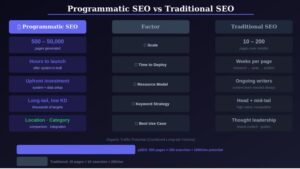
The key difference is that you should know when it’s best to use programmatic SEO vs. traditional SEO (this will help you to save time, money, and frustration).
|
Factor |
Traditional SEO | Programmatic SEO |
| Scale | 50–200 pages | Thousands of pages |
| Resources | Ongoing writers & editors | Upfront system build, minimal ongoing |
| Best For | Brand content, thought leadership | Location, category, comparison pages |
| Risk | Lower, steady, predictable growth | Higher reward but needs quality data |
| Time to Launch | Days per page |
Hours for entire campaign once built |
You should use programmatic SEO when you have a repeatable search intent, have an established data structure, and have category or location-based content. You shouldn’t use programmatic SEO for unique or opinion-based content or for content that requires additional research.
Step-by-Step: How to Launch Your First pSEO Campaign
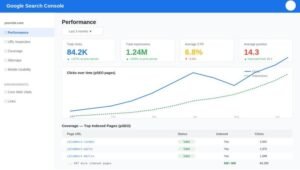
Step-by-Step Process for Launching Your First Programmatic SEO Campaign:
- Find your keyword pattern: Head Term + Repeatable Modifier – Determine what the head term will be and what your repeatable modifier will be. Example: “(service) in (city),” “(product) for (usage),” “(Tool A) vs (Tool B)” (not really practical for a head term)
- Build your data set (in Airtable or Google Sheets)—This is more important than quantity of information (100 records will be more accurate and complete than 1000 records that are messy and duplicates).
- Create a template page for all of your pages—Each page must contain a unique H1 tag, meta title, meta description, body copy that varies based on the subject matter, schema, internal links, and a Call to Action (CTA).
- Once your pages are created, submit a sitemap and monitor the progress of your new pages using Google Search Console to determine their status as indexed. Start by creating 50-100 pages, monitoring the indexes of your new pages, and growing larger.
No-Code Tools: Webflow, InstaRank, and Whalesync are great examples of no-code tools that allow you to create programmatic SEO websites without writing any code.
Common Mistakes Beginners Make (And How to Avoid Them)
Most programmatic SEO campaigns fail for one of three primary reasons. All of those reasons are preventable:
- Thin Content: By swapping out a single variable across 10,000 similar pages, you have not created unique content. Google de-indexed 98% of a large travel website’s 50,000 pages for multiple repeats due to this. You need to create more than just the same page 10,000 times; each page needs to add value to each person using the page.
- Orphan Pages: Pages that have no internal links will almost always be missed by Google’s crawlers and so don’t get indexed. You must create Hub Pages to link to your programmatic pages (imagine building roads to your pages).
- Mass Launch: Publishing thousands of pages at once can trigger spam indicators. Always publish in batches of 50-100, monitor indexing patterns of your pages, and scale up after you have determined that you have good indexation results.
A Real Statistic: Google’s Helpful Content Update (2023–2024) de-indexed millions of low-quality auto-generated pages; however, sites that were created with true structure and value received higher SEO rankings than before.
Frequently Asked Questions
Q: Does programmatic SEO still work in 2025?
Yes, when you utilize unique content and offer real value to users. In Light Of Google’s Helpful Content Updates, Programmatic SEO Will Work Best Only When You Utilize A Combination Of Structured Data & Editorial Management. Simplicity has no longer been removed from ranking algorithms; therefore, simple style templates are no longer viable ranking mechanisms for Google.
Q: Do I need to know how to code to do programmatic SEO?
Not With Tools Such As Webflow, Airtable, And Whalesync, Which Allow You To Create Your Programmatic SEO System Without Writing Any Code (Using Google Sheets As Your Database And A CMS That Allows You To Create Dynamic Content).
Q: How many pages do I need for programmatic SEO to work?
There is no specific number but rather a specific campaign, generally between 100 and 500 pages total, which uses quality targeted keywords (and all of them have the same keyword type); this campaign will outperform a campaign with 50,000 pages of low-quality content.
Q: What is a good example of programmatic SEO?
An excellent example would be Zapier’s implementation—they have generated pages that allow users to create integration(s) for each pair of available apps in Zapier (Gmail + Slack, for example). These generated pages target thousands of long-tail keywords while providing relevant content that is useful/helpful to visitors.