

How to Lower Your Google Ads Cost Per Click (CPC) in 2026

Introduction
Average Google Ads Cost Per Click (CPC) rates are on the rise across almost every industry, making digital real estate more expensive than ever. If you are not actively optimizing your Google Ads account, not only are you losing to competitors, but you are also overpaying. Increasing your budget is no longer a viable option; instead, the goal for 2026 is learning how to reduce your Google Ads Cost Per Click without losing traffic.
The key to success is not having more money; it is being efficient. Recent data has made it clear that relevance is the ultimate currency. Increasing your Quality Score from a 5 to a 10 can reduce your Google Ads Cost Per Click by up to 50%. By learning the technical aspect of your Google Ads campaign, you can beat your competitors who are spending more but optimizing less.
Understanding the Google Ads Auction
In the Google Ads auction, the advertiser who bids the highest does not always win the auction. In contrast to the conventional auction house where the one who spends the most money wins, the Google Ads algorithm focuses on the end-user’s experience. This means that an advertiser who spends less money on their bid can win the auction if their ad provides the best answer for the searcher’s query.
The Google Ads Cost Per Click you pay will be determined by your Ad Rank calculation. Your Ad Rank is calculated based on the amount you bid, the Quality Score you achieve, and the impact of your ad extensions. By using relevance and competitor bench-marking, you will be able to reduce the bidding floor for your keywords, thus paying the minimum amount possible.
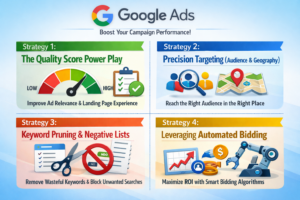
Strategy 1: The Quality Score Power Play
Quality Score is how Google determines how beneficial your ad is to a user. If you run a campaign with a high Quality Score, Google will reward you with a lower Google Ads Cost Per Click. In essence, Google is giving you a “relevance discount” on your CPC. This is the best way to increase your Quality Score and lower your Google Ads Cost Per Click without sacrificing ad reach.
To master this power play on Google Ads, there are three pillars to focus on:
- Ad Relevance: Your ad copy must directly relate to the keywords you’re bidding on. If a person searches for “web development,” your ad must feature those exact keywords at the top of your ad copy. It must not feature a generic ad title like “digital services.”
- Expected CTR (Click-Through Rate): Your ad must feature a compelling ad title. It must also feature a strong call-to-action (CTA) and ad extensions to make it more “clickable” than your competitors.
- Landing Page Experience: Your ad must not take people to a generic home page. Your landing page must be fast and feature specific content related to your ad.
Strategy 2: Precision Targeting (Audience & Geography)
Broad targeting is the quickest way to blow through your budget. In order to reduce your Google Ads Cost Per Click, you need to move away from the “broad targeting” approach. Serving your ads only to the most relevant users at the most relevant time and place will help you avoid wasting money on unnecessary clicks.
Proper geographical targeting will help you eliminate areas that cost too much and don’t generate any conversions. Using ad scheduling will allow you to serve your budget when your customers are most active. Serving the Google Search Partners Network can help you find cheaper clicks, as long as you monitor the quality of the leads.
| Targeting Method | Impact on CPC | Best For |
| Geographic Targeting | High (Exclude high-cost/low-conv areas) | Local Services |
| Ad Scheduling | Medium (Bid lower during off-peak hours) | B2B Lead Gen |
| Search Partners | Variable (Lower CPC, but often lower intent) | Brand Awareness |
Strategy 3: Keyword Pruning & Negative Lists
The fastest way to decrease your Google Ads Cost Per Click is to quit throwing money at “window shoppers” who have no intention of buying anything. There are a lot of advertisers out there who are having their Google Ads budget drained because they are bidding on broad keywords (keyword match types) and getting irrelevant searches. By performing a regular search term report audit, you will know exactly what is triggering your Google Ads and can eliminate the unnecessary.
The key to this is something called “Negative Keywords.” By adding words like “free,” “jobs,” or “research” to your negative keywords, you are making sure your Google Ads budget is only spent on the high-intent buyers. Another thing you can do is change your broad match optimization to phrase match optimization; this will give you more control over your budget and prevent the Google Ads algorithm from accidentally pairing your ads with expensive and irrelevant keywords.
Strategy 4: Leveraging Automated Bidding
Automated bidding is a powerful tool, and it must be managed to ensure cost-effectiveness. By tapping into the power of Google Ads algorithms to control your automated bidding strategy, you’re able to react to the millions of signals happening in real-time, which cannot be controlled by a human. However, the way to ensure that you’re able to keep your Google Ads Cost Per Click (CPC) costs under control with Google Ads is to move from a ‘Max CPC’ model to a ‘Target CPA’ model.
As you’re setting up a new campaign in Google Ads, a ‘Maximize Conversions’ model is set up with a defined ‘Target CPA’ cap to ensure the algorithm is able to go out and get the best lead possible without going over a defined cost point. This ensures the algorithm is not in a bidding war for an extremely competitive ad space in which there is not a potential return on investment.
Conclusion
In order to lower your Google Ads Cost Per Click , it is not the amount you are bidding but the relevance of your ad campaign. Being a master of Audience targeting options, Ad Scheduling, and having a well-organized Google Ads account is key to stretching your ad spend as far as possible. In the Google Ads universe, a well-planned strategy always beats increasing ad spend blindly.
AGTC is a leading ad agency for forensic audits to prevent wastage and deliver high-performing Google Ads campaigns. Our goal is to optimize your Google Ads campaigns for Quality Score and Geo Targeting to lower your Cost Per Click while increasing the quality of leads. Our team is at the forefront of Google Ads algorithm updates to deliver maximum ROI for every ad spend.
FAQs
-
Why is my Google Ads Cost per Click so high suddenly?
Sudden spikes are usually due to increased competitor bidding, a drop in your Quality Score, or your ads showing broad, expensive keywords that aren’t relevant to your landing page.
-
Does a higher Quality Score always mean a lower Google Ads Cost per Click ?
Yes. Google rewards relevance. A higher Quality Score lowers the “”entry price”” needed to maintain a specific Ad Rank, allowing you to outrank competitors who bid more but have less relevant ads.
-
Should I turn off the Google Search Partners Network to save money?
If you are on a tight budget, yes. While the Google Search Partners Network often has a lower Google Ads Cost Per Click , the conversion rate is typically lower. Test it for 30 days and compare the Cost Per Acquisition (CPA), not just the CPC.
-
How does Geographic Targeting affect my budget?
Different regions have different levels of competition. By using Geographic Targeting to exclude areas that don’t convert, you reallocate your budget to “”cheaper”” regions where your dollar goes further.
-
What is a “”good”” CPC for Google Ads in 2026?
It is industry-dependent. However, a “”good”” Google Ads Cost Per Click is one that allows for a profitable Return on Ad Spend (ROAS). If your conversion value is high, a $10 CPC might be “”cheaper”” than a $1 CPC that never converts.