AI Keyword Research: How to Find High-Intent Keywords


Introduction:
Searching for your audience through keyword targeting can sometimes seem like a hit or miss approach. AI has changed how we do keyword research. It removes the guesswork in finding relevant keywords for our content. AI now looks beyond just counting search phrases. It considers why people search for certain terms. This helps identify the specific phrases that potential customers use as they near a purchase.

AI keyword research lets you work faster and more efficiently than traditional methods. AI quickly analyzes large amounts of data. It helps find hidden keyword opportunities that your competitors might miss. High-volume and high-intent keywords help you reach an online audience. They really increase your chances. As a result, you’ll achieve greater business growth and much better search rankings in less time than ever before.
Why the Old Way of SEO Failing?
Ten years ago, in 2018, SEO relied heavily on numbers, like traffic and search volume. Marketers focused on high-volume keywords to boost website clicks. But now, those methods don’t work as well. Today’s search engines are much smarter. They consider the entire sentence and the intent behind the search, not just specific words.
Traditional SEO vs. AI-Driven SearchF
SEO has two main types:
- Traditional SEO or “old school” focuses on keywords and phrases for website interaction.
- Modern SEO or “new school” emphasizes meeting user needs in real-time.
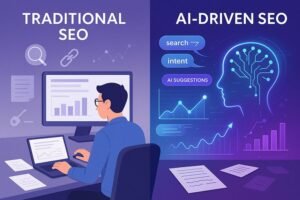
The rise of artificial intelligence has greatly influenced SEO. So, how we search for keywords has changed too. With AI keyword searching, we can elevate our game. It’s not just about using keywords anymore. Now, we can create real content that answers what people want for any keyword or phrase.
The Major Changes in 2026
- Searches with no clicks: Over 80% of users get information through A.I. These users find answers directly from the search engine and don’t visit other websites.
- Keywords matter: The search above shows that ‘short’ or ‘stubby’ keywords are less effective now. So, you need to focus on specific, high-intent long-tail keywords. This helps A.I. link you with experts in your field.
- Topic Development: When making a topic for the search engine, you combine ideas. This relies on how often you reference certain keywords. For example, if you were to use the word healthy, you would also be considered a reference point for the topics of meal planning or nutrition.
Traditional vs. AI Keyword Research
|
Feature |
Traditional Keyword Research | AI Keyword Research |
|
Process |
Manual spreadsheet filtering | Automated NLP clustering |
|
Focus |
High Search Volume | User Intent & Semantics |
| Speed | 4–6 hours per project |
15–30 minutes |
| Accuracy | Historical data (Static) |
Predictive trends (Real-time) |
Decoding Intent with AI Keyword Research
There’s a lot of info on keyword research, but it can be hard to know why someone searches for a specific keyword. Understanding this is where you’ll get the most value from your research.

In 2026, Artificial Intelligence (AI) will change how we extract keyword data. It will shift from non-semantic (literal) to semantic (meaningful) usage. This change will rely on Natural Language Processing (NLP) capabilities based on user intent. Using NLP capabilities will allow you to determine whether or not your users are in the buying cycle (i.e., “kicking the tires”) or whether or not the user(s) is ready to purchase (i.e., has usage of credit cards).
How AI Understands the “Buyer Intent”
AI acts as your Intelligent Sales Assistant by using keyword searches. This helps determine where the customer is in their buying process.
- The Browser is searching for “How To Fix A Leaky Faucet” (learning)
- The Buyer is searching for the “Best Plumber Near Me” or “Buy Kitchen Faucet Online” (buying).
AI keyword research will cut down on broad search terms. It will replace them with targeted keywords that drive sales.
Connecting the Dots with Semantic Search
AI now evaluates multiple contexts in addition to helping you find just one keyword.
- When you use semantic search, it gives you results with keywords related to your business. If you sell mountain bikes, semantic search can help. It might show related results like trail riding, mountain bike suspension, or off-road gear relevant to your business.
- A User Journey Map made with smart mapping helps create the right content. This content supports customers during their entire search journey.
Essential Tools for AI Keyword Research
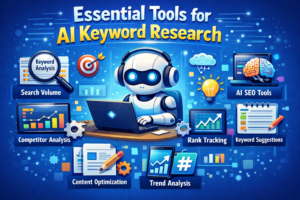
In 2026, you won’t need many tools. Just a few powerful ones that work well together will do. You won’t need to enter data by hand anymore. AI Keyword Research now uses agentic workflows. An AI assistant handles all the work for you.
To create an effective strategy, group your tools by purpose. Use two categories:
- Discovery: for finding ideas.
- Clustering: for grouping ideas.
|
Category |
Goal | Top Tools for 2026 |
|
Idea Discovery |
Brainstorming fresh angles and long-tail variations. | ChatGPT, Google Gemini, AnswerThePublic. |
|
Data Validation |
Checking real-time search volume and difficulty. |
Semrush, Ahrefs, Google Keyword Planner. |
| Smart Clustering | Grouping keywords into “Topic Hubs” automatically. |
Nightwatch AI Agent, Keyword Insights, Surfer SEO. |
| Live Monitoring | Tracking how you rank in AI-generated search answers. |
Nightwatch AI Agent, Siftly.ai. |
Section 4: A Step-by-Step Framework to Find High-Intent Keywords
To achieve a high return on your investment in a business, you need a well-thought-out plan. This plan should support future growth. By the end of 2028, top companies will create a topical ecosystem. They won’t just look for keywords for their marketing plans. An established AI-based keyword research tool helps you build your marketing strategy. It focuses on what people want to do, not just how they search for it.
Step 1: Seed Generation (Finding the Roots)
An excellent strategy starts with a seed – the main subject that describes your company. Instead of thinking of what to ask, you should ask a question using AI to develop ideas.
- One question could be: “As my ideal consumer, what five things frustrate you about [product category]?”.
- The goal is to use the questions generated by AI to help develop a list of true keywords that represent real-world problems.
Step 2: Clustering (Building Your Content Pillars)
Keyword clustering is essential if you have over 500 keywords; you need to treat them as more than just a flat list.
- How do you cluster keywords? You use AI-supported Keyword Research tools to group keywords based on Semantic Similarity – that means combining keywords that have the same intent, or goal (for example: Best Laptop to Buy for Kids vs. Computer That Will Last the Longest for Students).
- Creating AI Content Pillars around those keywords will improve your site’s authority, as Search engines will value your coverage of a particular topic in 2026 more than they will thin coverage of a given subject on numerous pages.
Step 3: Competitor Gap Analysis (Finding “Quick Wins”)
As of right now, many of your competitors are already ranking for keywords and/or phrases that your business is not – AI can quickly and easily expose these gaps (opportunities) with an overview of each of your competitors’ keyword rankings/presentation.
- Low-Hanging Fruit – You can compare your website and one of your five competitors using the AI tools; if a keyword ranked for that competitor is ranked at “1”, but has absolutely no content on your website associated with it – this would be a “low-hanging fruit” opportunity.
- Opportunity – Look for other keyword (topic) gaps that your competitors are ranking for; if the information presented by them is dated or poorly written in comparison to how you write, then these will be your best targets moving forward into 2026 and beyond.
Section 5: Beyond Search Volume – Predictive SEO
By 2026, using past data for decision-making will be considered futile since AI-driven Keyword Research has transitioned away from retroactive analysis of searches done by users to predicting future searches by users. This method of future search data is known as Predictive SEO. AI can now accurately project the most popular searches for users in each subsequent search season (quarter) rather than just tracking the search history from yesterday or last month.
Section 6: Common Pitfalls and the “Human + AI” Synergy
AI does help with AI keyword research at an accelerated pace, but it is not error free or completely accurate either – therefore, in the year 2026 the best method for getting great results will be by working in conjunction or in partnership with both Human and AI… AI will do most of the analytical work while humans provide the overall strategy and human driven empathy.
Predicting Trends Prior to Their Peak
AI algorithms examine multiple social media platforms and other sources of information, including newspapers and other markets, to identify “Zero-Volume” key words that are about to take off. You can use this to gain an early advantage by generating content around these key words and achieving the #1 rank before any of your competitors are aware of the trending topic.
New Trend of 2026: Predictive Scoring
There will be a significant shift in 2026 – the introduction of Predictive Scoring Tools (in AI). Instead of reporting on just the volume (number) of monthly searches for a keyword like before, AI algorithms now rank keywords according to their likelihood of converting into a sale. Just because a keyword has an average of 50 vs. 5,000 searches per month doesn’t matter if the AI has determined that the 50 potential buyers are ready to purchase immediately, while the other 5,000 are not likely to purchase at any point in time.
Blind Trust Can Be Risky for You
AI is known to occasionally experience hallucinations (for example, when it comes up with keywords that do not actually exist) and consequently could easily lead to you writing hundreds of pages of content on terms that no one has EVER used! So always ensure to review everything before putting too much time on writing or content creation!
Success Checklist

- Verify Your Data: Use something like Ahrefs to confirm what the AI says about search volume
- Manually Search: Check the “Live SERP” (Search Engine Results Page) to see if the content that is currently ranking relates to what you are going to produce
- Maintain Your Brand’s Voice: Your brand should not sound robotic due to AI use, so ensure your words align with your voice when you’re using those keywords.
Conclusion
As 2026 approaches, one thing is clear: AI Keyword Research has become a requirement rather than an option for businesses. Due to a decrease in the relevance of traditional search volume in conjunction with the use of AI for generating answers and zero-click results, having a high-intent keyword strategy is your only opportunity for being visible and seen as an authority by your customers. By utilizing these tools now, you will not only find the terms that customers use when researching products, but you will also leverage AI Keyword Research to grow your SEO and effectively engage with your customers at the level at which they are purchasing products.
The transition from “ranking in order to get a click” to “dominating in order to create intent” will require a partnership with an organization that understands the new business rules. AGTC Services has the skill set and experience necessary to help you lead your industry through AI-driven SEO strategies that turn complicated searches into simple, profitable sales. Please don’t wait on your competition to get ahead of you in the future. Contact AGTC Services today for an audit of your current strategy & start your path toward achieving search excellence with AI-based tools.
Keyword research is all about intent and visibility in the new world of AI-based results – below is a simple outline to help you navigate your way through AI Keyword Research.
You May Also Like
1) Mastering SEO Strategy in 2025: A Comprehensive Guide
2) What is SEO? Why it’s important
3) Master SEO for 2025: From Organic Traffic to Conversions
4) AI-Powered SEO: Future-Ready Strategies
FAQs
How to find high-intent keywords?
Filter your research for “action” modifiers like buy, pricing, or vs. to catch users ready to spend. High-intent keywords are best found by analyzing your competitors’ paid ads and your own high-converting pages.
How to find AI overview keywords?
Focus on long-tail questions (who, what, why, how) that trigger Google’s AI summaries. Use tools like AnswerThePublic or check “People Also Ask” boxes to find the exact queries AI uses to generate snapshots.
Which AI tool is best for keyword research?
Semrush is the top all-in-one choice for its 25B+ keyword database and AI intent labeling. For tracking your specific visibility in AI-generated answers, Nightwatch AI Agent is the specialized leader.
Can I use ChatGPT for keyword research?
Yes, ChatGPT is excellent for brainstorming “seed” ideas and clustering keywords into topics. However, it lacks real-time traffic data, so you must always validate its ideas with a tool like Ahrefs or Google Keyword Planner.
How do I find profitable keywords?
Target keywords with a high “Predictive Score” that balances low competition with high commercial value. Focus on “long-tail” phrases (4+ words), as they have higher conversion rates and lower costs than broad terms.
What are the 4 types of keywords?
- Informational: Seeking knowledge (e.g., “how to fix a sink”).
- Navigational: Seeking a specific site (e.g., “Amazon login”).
- Commercial: Researching products (e.g., “best laptops 2026”).
- Transactional: Ready to buy (e.g., “buy iPhone 17 Pro”).