

AEO Guide 2025: Answer Engine Optimization for AI Visibility

Introduction:
The way we search is evolving and it is an evolution that is happening very quickly; examples of this are Google AI Overviews, Perplexity, and ChatGPT (instant answers), and now users are not limited to clicking on traditional blue link results. Brands that want visibility in the year 2025 will need to be aware of and optimize for not only search engines but also answer engines.
Answer engine optimization (which is the practice of optimizing content so that AI platforms like Google AI Overviews and Perplexity can “read” (understand), “confirm” (verify), and “show” (feature) your answers), is how brands will ensure their content becomes the trusted source for AI in its zero-click results.
What is AEO (Answer Engine Optimization)?

Answer engine optimization is the process of optimizing content for AI platforms. In other words, AEO is SEO adapted to meet the needs of an AI-summarised world.
According to research, about 60% of Google searches end in zero clicks – meaning that users are able to find what they need from summary or snippet results by AI without having to click on a website and visit it.
Answer engine optimization focuses on:
- Conversational queries;
- Answer engines and snippets;
- Geo entities (people, brands, locations, concepts);
- Structuring content in a way that makes it easy for AI to identify a particular piece of content as being the “best” or most accurate answer;
- And businesses can use AEO to enhance brand visibility, even if a user does not click, in the era of zero-click AI-first search.
AEO vs SEO vs GEO: Key Differences
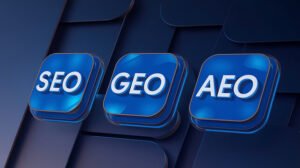
As the search landscape continues to change, understanding the differences between AEO (Answer Engine Optimisation), SEO (Search Engine Optimisation) and GEO (Google Entity Optimisation) has become increasingly important because all three have been created to provide different levels of visibility to your business through the use of AI technology. Traditional SEO is all about SEO ranking content in the search engines based on its relevance; however, GEO (Google Entity Optimisation) is all about positioning your brand as an authoritative source within Google’s ecosystem. In contrast to SEO and GEO, AEO is concerned with making sure your content is perceived as the best AI-generated answer for relevant search queries.
While AEO is concerned with semantic search, area of expertise and other signals associated with E-E-A-T (Expertise, Authoritativeness, and Trustworthiness) such as schema markup, all of which will help engines to determine the context of your business’s content, GEO is focused on creating topical authority for your business by being recognised in Google’s Knowledge Graph.
To differentiate between how AEO, SEO and GEO use long-tail keywords, think of it this way:
While SEO focuses on the keyword phrases that users type in, AEO focuses on the intent, entity and semantic keywords that AEO systems will use to determine the best response to a user’s query.
AEO vs SEO vs GEO – Comparison Table
| Criteria | AEO (Answer Engine Optimization) | SEO (Search Engine Optimization) | GEO (Google Entity Optimization) |
| Primary Goal | Appear in AI answers & zero-click summaries | Rank higher on search results pages | Strengthen brand/entity identity in Google’s system |
| Focus | Conversational queries, semantic understanding, E-E-A-T | Keywords, backlinks, on-page optimization | Entities (brand, people, locations), Knowledge Graph |
| Content Type | Structured answers, FAQs, how-to content | Blogs, landing pages, keyword-targeted content | About pages, profiles, citations, NAP consistency |
| Signals Used | Semantic keywords, schema markup, E-E-A-T signals | Keywords, metadata, site speed, links | Entity markup, verified profiles, topical authority |
| User Behavior Target | AI Overviews, Perplexity, ChatGPT Search | Organic Google traffic | Branded searches, knowledge panel visibility |
| Best For | AI visibility, zero-click exposure | Traffic growth, rankings | Brand trust, credibility, entity recognition |
| Long-Tail Strategy | Intent-based phrasing & question queries (AEO vs SEO GEO long tail keywords) | Keyword-driven long-tail variations | Entity-driven long-tail (brand + topic combinations) |
AEO Strategies

Long-tail keywords are a critical element of an answer engine optimization (AEO) strategy moving into 2025. In contrast to traditional search engine optimization (SEO), Answer engine optimization is focused on using long-tail keywords that represent the user’s search intent, and on providing that information structured in a manner that aligns with how artificial intelligence (AI) tools, such as Perplexity and Google AI Overview, will read and interpret your information when they respond to conversational queries.
-
Start with an Visibility Audit
Perform an audit of your brand’s visibility within AI tools. Perform a test to evaluate your brand on each of the following AI tools by searching various questions related to AEO strategies for businesses in 2025, including “What are AEO strategies?” or “What’s the best way to implement long-tail keywords for AEO?”
During this visibility audit you want to know the following:
- Is your brand being referenced within the AI tool?
- Does the AI tool provide accurate information regarding your brand?
- Is your industry represented accurately within the AI tool (i.e., a business that sells dog food will not be listed in the “Automotive” section)?
If your responses to the above questions are NO, you do not have trustworthy content that AI tools will recognize as reliable entities.
-
Focus on Long-Tail Keywords + Intent Matching
Discover long-tail keywords that represent your users’ intent using the search queries shown below.
- “Best AEO strategies for local businesses”
- “How do I implement long-tail keywords into an AEO Strategy?”
Each of these search queries matches:
- Conversational Intent
- Question based searches (for example: How do I…)
- Multi-step user problems (for example: Where can I find…?)
All of these increase your chances of being mentioned/cited by answer engines.
-
Structure Content in Q&A + 50-Word Answers
Structure your content for AEO in a Q&A format using the following tips:
- Create FAQ blocks in your content.
- Create “People Also Ask” type of Q&A in your content.
- Provide 50-60 word direct answers to user questions.
-
Create Geographic Signals (NAP Consistency)
For Local Answer Engine Optimization: Utilize your Name, Address and Phone Numbers on all of the following platforms: Google Business Profile, Directories and Social Profiles. Having consistent GEO information allows AI to use it to confirm the validity of your entity data, and therefore it improves your localized answer rank amongst others.
-
Create Schema Markup
Markup your content using one or more of the following: FAQ Schema, HowTo Schema, and LocalBusiness Schema for NAP and GEO information. Markup will assist Answer Engines to identify your content as Authoritative and Structured.
-
Track AEO Performance
You can monitor your AEO performance using tools such as: Ubersuggest (Get Long-Tail Keyword Ideas & Gaps in Content), Search Console (AI Overview, Impressions, Etc.), and Perplexity Analytics (if available to you).
AEO Keyword Research

AEO keyword research includes all of the Semantic and GEO entity information that Answer Engines require to deliver accurate answer engine response results, but does not use just Search Volume. AEO keyword research also includes long-tail keywords.
-
Use Long Tail Low KD Keys
You should initially look for Low KD Long-Tail keywords using a tool like Ahrefs. Some keyword examples for AEO long-tail keywords would be:
“How to implement AEO for Local Business”
“AEO Keyword Research for AI answer”
“Semantic Keywords AEO for 2025”
Low KD Long-tails often receive greater AI summaries because they are an Exact Match to Conversational Queries.
-
Semantic Clusters and NLP Keywords
The answer engines use the NLP technology to analyze synonyms as well as to find the context for the keywords used. Create Groupings that contain:
- intent phrases – (e.g. “How do I set my business up for answer engines?”)
- synonyms – (e.g. AEO vs AEO (Answer Engine Optimization), AI visibility and AI Snippets).
- action oriented verbs – (e.g. implement, optimize, structure, valida
The creation of Clusters of Semantic Keywords will greatly enhance your chances of being included in an overview or answer created by AI and Perplexity.
-
Creating Keyword Maps for Users
Every long-tail keyword must be associated with a question that your target audience is asking.
e.g. “What is the process for implementing Answer Engine Optimization for my website?”
e.g. “What does GEO Equivalents mean in the context of Answer Engine Optimization?”
e.g. “What is semantic search optimization?
AI recognizes Content that matches the Intent of the user, and as such, receives a higher Place in Answer Engines.
-
Strengthening GEO Keywords and Entities
Answer Engine Optimization relies heavily on GEO signals. Only through the use of a Knowledge Graph can an Answer Engine validate data. Ensure Your Entity Matches:
- Location Based Queries (i.e. “Where to find Answer Engine Optimization service in Coimbatore?”)
- Entity Based Keywords (i.e. Brand, Category or Industry).
- NAP Linked Phrases i.e. (Local Business Name + Service/Product).
- All Geo-linked Entities, Consistently improve Visibility of Local Answer Engines.
-
Adding Keywords that AI Models Prefer
Keywords Set-up in NLP-Friendly Structures
“Best Way to….”
“Step By Step Guide…”
“What is the Process…”
When Setting up Content for AI, the Models would be able to Identify these Structure Patterns and will Reference them more Often in the Summaries they Create for Zero-Clicks.
Best AEO Tools
Selecting proper tools for Answer engine optimization 2025 can significantly enhance how businesses interact with Google’s AI Overview; the Perplexity tool; and any other AI driven interfaces. All of the tools offer the same basic services: helping businesses create and manage their content; determining entities; and monitoring how (and when) businesses/professionals are mentioned by an AI (corporation or other) in response to user search queries. Additionally, using GAO tools will provide the necessary data to improve GEO accuracy.
-
SurferSEO
SurferSEO recently introduced the Answer Engine Optimiser, which provides businesses with:
- Real-time Natural Language Processing software
- Readily available keyword suggestions in order of relevance
- AI-based intent scorings
Using the SurferSEO is particularly helpful for scale content meant for long-tailed queries to answer engines..
-
Gauge.ai
Gauge.ai allows companies/individuals to determine where their brand is being mentioned and/or displayed across all AI-driven platforms.
This information is critical in measuring the overall success of your AEO efforts within any given time frame by tracking keyword and brand visibility within the specified period.
-
AnswerThePublic
AnswerThePublic is a tool that will allow businesses to determine what kinds of questions users are asking. Overall, this is a tremendous resource for discovering long-tailed phrases that correspond with AEO strategies.
Use AnswerThePublic to develop user-generated intent questions such as:
- “What are the best AEO tools for local businesses?”
- “How do I optimise my GEO internally?”
-
Schema Generators
Schema Generators like Merkle’s provide the ability for a business to implement:
- FAQ schema
- How-To schema
- Organization + LocalBusiness schema
Having these types of schema allows answer engines to better understand the purpose of your content and helps to establish the relevance of your content relative to GEOs.
-
Tools for Validating Entities
Entity validation tools include:
- Kalicube Pro
- Google’s Knowledge Panel Checker
These type of tools can check if the GEO entities for your brand are recognized correctly in Knowledge Graphs.
-
AI Monitoring Tools
There are numerous tools available to keep track of where/when AI Models are accessing brand information, such as:
- Brand24
- Mentionlytics AI Tracking.
In order to improve your presence in AI-generated snippets, it is very important that you know the locations where they’re pulling information from about your brand.
Measure Success
Tracking the Success of AEO is based on more than just rankings; you should also track how frequently AI Systems are using your content as the best answer to a question or query.
-
Track Snippet Impressions
To accurately measure the Success of your Answer Engine Optimization programme, you will need to maintain continuous track of your visibility across the following areas:
- Snippet impressions (Tracking in Search Console)
- People Also Ask Visibility (Tracking in Search Console)
- AI Overview Exposure (Gradual Rollout).
High numbers of Snippet Impressions indicate more robust tracking of your Answer Engine Optimization efforts.
-
Test AI Platforms Directly
Test your Target Queries (Keyword Phrases) on the following platforms:
- Google AI Overview
- Perplexity
- ChatGPT
- Bing Copilot
Determine how frequently your content is displayed.
If your Domain is repeatedly being referenced by AI, you can conclude that your Answer Engine Optimization efforts are yielding the desired results.
-
Analysis of GEO Signals and Entity Recognition
For Effective Answer Engine Optimization, it is critical that Accurate GEO Signals exist. Validate the following:
- Consistency of NAP (Name, Address, Phone Number)
- Local Business schema implementation
- GEO Entity Presence in Knowledge Graphs (KTG)
If your Company doesn’t have Accurate GEO Entities documented, then the Answer Engines will not include you in their results.
-
Refresh Content Regularly
Content that has not been updated for a long time is one of the most often overlooked areas when it comes to Answer Engine Optimization, this includes not only keeping your content fresh with new data and examples and Geo cues, but also regularly revising your internal links.
When you regularly bring attention back to your content every 60 to 90 days with new relevant information, it increases the chances of having your content selected by Google as the best answer.
- data
- examples
- internal links
- GEO cues
This boosts your likelihood of being selected as the “best” answer.
-
Avoid Keyword Stuffing
The overuse of key terms can often distort messages, create confusion, and may limit the value of many of the best response genes. Write clear, concise answers that directly respond to users’ queries.
Conclusion
Answer Engine Optimization will soon be the new standard of visibility for businesses operating on the web because of how quickly artificial intelligence is changing users’ way of finding information.
Promoting content that is optimized for conversational searches like questions and snippets as well as using geo-entity types will make your brand the most trusted source of information through Google’s Answer Engines, Perplexity, and other up-and-coming engines. The companies that adapt and change now will lead the next evolution of search.
If staying ahead of the competition in the AI-enhanced world is important to you, then you should reach out to Active Growth Tech (AGTC) about implementing your complete AEO strategy, optimizing your Answers Engine content, and increasing your geo signals to achieve the best visibility possible. Are you ready to dominate AI search? Go to activegrowthtech.com or send an email to activegrowthtech@gmail.com to get started.
FAQ
-
What is AEO?
AEO is the term used to describe the process of preparing your content so that AI websites and tools like Google AI Overview, Perplexity and Chat GPT can choose your page as the best available answer. To achieve this, Answer engine optimization creates a structured format for your content, uses long-tail keywords and focuses on creating clear, well-defined entities, all of which serve to enhance your zero-click visibility and build your Affiliate Authority for AI-generated results.
-
What’s the difference between AEO, SEO, and GEO?
In terms of their purpose, AEO targets AI answers and snippets, SEO targets search engine rankings and clicks and GEO is focused on the management of your business entity and local presence.
These three elements can be combined to create the most powerful visibility strategy available for 2025 and beyond.
-
What are the best long-tail keywords for Answer Engine Optimization?
Effective long-tail keywords for AEO are likely to be the sort of low-competition, conversational phrases or questions, such as “AEO for small businesses,” “How do I get into the AI answers?” or “Tips for local AEO optimisation.” The above show examples of keywords for Answer Engine Optimisation that can be used to help match up the content you are producing with what the audience expects to see in their search results.
-
What schema markup improves AEO and GEO performance?
The best schema markup for AEO and GEO is FAQ Page schema to create answers that are clear for both users and AI systems, as well as Local Business JSON-LD for validation of your business’ entity. Both of these schema types help AI systems know they can trust your content, understand geographical signals, and extract accurate business information to display in snippets, maps, and AI-generated summaries.
-
What are the best AEO tools?
The following tools should be on every Answer Engine Optimization toolkit list: SurferSEO (for helping with semantic optimisation), Gauge (for monitoring AEO with respect to semantic performance), AnswerThePublic (for generating answers to conversational queries), and Merkle Schema Builders (for technical markup). These tool types will improve the accuracy of answers provided by AEO, keyword mapping and AI visibility.
-
Does AEO help with voice search?
Yes. Short, conversational answers work best for AEO voice search. When combined with NAP voice consistency (the name, address and phone number of your business) AEO helps voice assistants provide accurate responses based on your location.